Wolf–caribou ecological balance
Never Cry WolfWolf–caribou ecological balance is the reciprocal relationship the book sets against the popular claim that Keewatin Barren Lands wolves indiscriminately deplete Caribou. In the account, wolves usually test rather than simply pursue herds, take animals least able to survive, and stop hunting once their needs are met. Their numbers, in turn, are limited by food availability, breeding conditions, and disease. The balance is not depicted as immune to disruption: changing prey conditions and human interference can expose both wolves and Caribou to pressures that the rhetoric of wolf control obscures.
The Wolf’s Place in the Food Web
The account’s first challenge to a narrow predator-prey picture comes from the wolves’ diet. In the summer, sphagnum bogs support abundant small rodents; as June gives way to July, lemmings and other mice become especially numerous. The narrator initially cannot reconcile apparently well-fed wolves with their nightly hunts, since he sees them return without bringing prey home. His later observations overturn the assumption that large game must account for their condition: Keewatin Barren Lands wolves at Wolf House Bay, and by inference other wolves raising families beyond the summer Caribou range, live largely or almost entirely on mice.
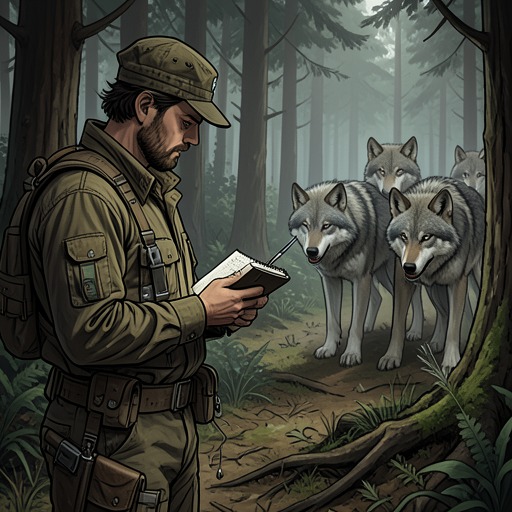
The evidence builds from observed behavior as well as inference. The narrator watches Angeline pounce repeatedly in the grass and sees her eat twenty-three mice; he later understands that adult wolves return to the den and regurgitate food for the pups. Ootek confirms the importance of mice and adds other prey to the picture. Keewatin Barren Lands wolves also eat Ground squirrels, which can provide a substantial meal at lower energetic cost than a Caribou hunt. Ootek reports that wolves fish for Northern pike in narrow marsh channels during the spring spawning season, and can catch several in a short time. These varied food sources make the wolves’ survival less dependent on any single large prey species.
Scat analysis offers a separate check on the narrator’s observations. About 48 percent of the samples he examined contained rodent remains, while other identifiable items included Caribou bone and hair, bird feathers, and a corroded brass button. The button’s unexplained presence is not treated as proof of an unusual meal. Taken together, direct observation, Ootek’s knowledge, and the scat evidence challenge the familiar image of wolves as predators sustained only by large game.
Testing the Herd and Conserving Effort
Ootek explains that a healthy adult Caribou can easily outrun a wolf, and that even a three-week-old fawn can outrun all but the fastest. The animals’ relative speed shapes the hunt: Keewatin Barren Lands wolves seldom try to run down healthy Caribou because the effort is unlikely to succeed. When herds are abundant, they rush through a group briefly, testing whether the movement reveals a sick, wounded, or otherwise inferior animal. If none appears, they abandon the pursuit and move on to another group.
When Caribou are scarce, wolves may work together to drive a small herd toward an ambush, or use a relay in which one pursuer drives the animals toward another. These tactics improve the wolves’ chances, but the account still presents the outcome as selective: the animal least able to escape is most likely to be caught. In the hunts the narrator subsequently watches, the wolves often trot among dispersed Caribou that appear unconcerned. A brief dash makes a herd run; if the animals demonstrate that they are in good condition, the wolves stop and let them go.
The narrator distinguishes this testing from indiscriminate pursuit by describing which animals attract attention. Prime bucks in peak condition are rarely tested because the wolves cannot catch them. Herds containing fawns and groups of aged or weakened females offer more possibility of finding an animal unable to keep pace. Even a fawn may be pursued for a few hundred yards and then released if it shows no weakness. The process can continue for hours before a vulnerable animal is found, making economy of effort central to the account’s explanation of wolf behavior.
A successful hunt does not, in this telling, lead to continued killing for its own sake. Once the wolves obtain sufficient food, they stop hunting until the supply is exhausted. The narrator examines the remains of sixty-seven wolf-killed Caribou and finds that the wolves have used nearly all of each animal, including parts people might otherwise consider inedible. His observations support the argument that a kill is food to be used, not evidence of a surplus slaughter. He also notes signs of disease or debility in many of the remains, including worn teeth and bone abnormalities; some freshly killed animals he examines are heavily parasitized. Such evidence strengthens his interpretation that the wolves often remove animals already in poor condition.
Population Limits and a Prey-Crisis Year
The account presents population regulation as a set of constraints rather than a single mechanism. The number of available wolf homesteads is limited, and litter size varies with food availability and the abundance of wolves. When food is plentiful, or wolf numbers are low, a female may have a large litter, sometimes as many as eight pups. When wolves are numerous or food is scarce, a litter may contain only one or two. The book compares this responsiveness with that of rough-legged hawks, whose egg production also falls when mice and lemmings are scarce.
Disease is described as a further check when other limits fail. If wolves become too numerous for their prey base, scarcity weakens them, and the account says rabies, distemper, or mange can spread and reduce their numbers. This is not presented as a painless or dependable balance: it is a severe consequence of a breakdown in the conditions that sustain the population. The narrative particularly links such breakdowns to human interference, while allowing that food scarcity can also arise through natural cycles and migration changes.
The 1946 crisis makes the interdependence stark. Lemmings, whose abundance in the Canadian Arctic follows a roughly four-year cycle, were then at a low point. At the same time, depleted Caribou herds changed their customary migration and largely bypassed southern central Keewatin. The resulting shortage affected people, foxes, and wolves. Rabies that had been latent among starving foxes flared up and also affected wolves. The episode shows how a decline in small prey and a change in Caribou movements can converge, bringing hunger and disease across species rather than revealing a simple contest in which wolves alone determine the fate of the herd.
Human Pressures and the Argument for Balance
The book’s account of ecological balance is also an argument about who gets to define imbalance. Government bounties, generally ranging from ten to thirty dollars per wolf, reward killing and can function as a subsidy to trappers and traders when fur prices are low. In one winter, a trapper working along the Manitoba–Keewatin boundary collected bounty on 118 wolves, 107 of them young animals born the previous spring. Rather than killing them only by trapping or shooting, he used strychnine across a wide area; the poisoning also wiped out foxes, wolverines, and other small carnivores. The economic value assigned to wolves, rather than the wider effects on the food web, shaped the action.
Other forms of organized hunting reinforce that pressure. The book describes aircraft used to pursue wolves across open ground, exhausting them before hunters shoot. It also recounts a government-backed Caribou trophy-hunting scheme: parties of visiting hunters paid a thousand dollars each for organized safaris and a guaranteed set of antlers. Government aircraft could be used to locate and gather herds, enabling the hunters to take animals before selecting trophies. In another policy example, Quebec’s Minister of Fish and Game decreed a contest aiming for 5,000 dead wolves, with prizes made from wolf jawbones. These measures sit uneasily beside the book’s account of wolves selecting vulnerable Caribou and using their prey rather than killing without limit.
By the end of his observations, the narrator regards Ootek’s thesis—that wolves help keep Caribou strong—as increasingly persuasive, while recognizing that his employers may not accept it without material proof. His collections of parasites from wolf-killed Caribou begin as an effort to make the case convincing to them. That turn from inherited belief to observation gives the ecological argument its structure: diet, hunting behavior, carcass evidence, population limits, and human policy are considered together. Wolf–caribou ecological balance is therefore not a claim that predation has no cost, but a challenge to treating every wolf-killed Caribou as proof that wolves are the cause of a failing herd. It places the predator within a wider system—and asks the reader to account for human pressures as part of that system, too.